
PMP25: Illini Rule Changes
Okay, NOW I've completed all of the 2025 Pick My Post articles. Last year's fundraiser was a bit of a mess (with the donation website working and then not working and then working again and then not working again) but I've heard from the two people whose articles hadn't been written and this is the second of those two articles.
And it's a fun one. The question:
The article I would most like to read is a deep dive on all rules that have been changed in all sports (I am sure there is a golf rule somewhere out there with the Illini's name on it) because of something that has happened to the Illini and the NCAA have instituted the Illini rule the next season. Then in your opinion is there a moment in Illini sports history that SHOULD have been Illini Ruled but wasn't?
Thanks for all you do! Your words really do act as a meditation device for me. Keep up the amazing work.
- Elizabeth
There are, to me, five rules changes that come to mind. But there's a Big Three here and those three rules changes are the reason Illini fans hear of a new rule change and immediately think "how did Illinois get screwed before the NCAA changed this rule?" They are:
- NCAA Tournament games cannot be played on another team's home court (since Illinois-Kentucky in the Elite Eight in 1984).
- Replay came to college football because of the Illinois-Michigan football game in 2000.
- Out-of-bounds replay came to college basketball because of Illinois-Miami in the Round of 32 in 2013.
I'll go into detail about each below, but I first wanted to establish why this is a thing. We lost at Kentucky on a controversial call in 1984 and the ref flinching but not blowing his whistle made the NCAA say "maybe we shouldn't play these games on someone's home court." We lost to Michigan in 2000 after two terrible fumble calls and that changed the next offseason vote from "against replay" to "for replay" for the majority of Big Ten schools. And we lost to Miami in the 2/7 game in 2013 on a ball that clearly went out of bounds off Miami (but the officials had no way to change it) and that tipped the scales for college basketball replay.
Because of those three things, Illini fans will forever be wary of officials. We're the girl cheated on by three boyfriends being asked to trust the fourth boyfriend when he's having dinner with a coworker on a work trip. All we can think is that after the next cheating episode, which will obviously happen any minute now, the company will probably change their policy about dinners on work trips.
Right to it. Here are the five rule changes brought about by something that happened to the Illini.
1. No NCAA Tournament Games On Home Courts
The Dicky Beal Game.
Illinois makes the Elite Eight in 1984, one game from our first Final Four since 1952. But now we have to play Kentucky AT RUPP ARENA. And wouldn't you know that an official was afraid to call Kentucky for traveling in the final 10 seconds of the game.
I'll just get to the clip. And I'll remind you that this was 1984 and basically taking a single step was a travel back then. You can hear the crowd screech. The announcer says he "almost traveled." Dicky Beal has been known to tell Kentucky fans at speaking events "yeah, I traveled." But it wasn't called:
It was after this game – a close game that felt like a home game where all of the 50-50 calls went to the home team – the NCAA announced that tournament games could no longer be played on the home team's floor. Starting in 1985, you could play in your city (like playing Houston in Houston back in March) but you could not play in your arena. What used to be an NCAA Tournament with things like the "Lexington Regional" then became the "Atlanta Regional" with games played in mostly NBA arenas.
You're welcome, everyone.
Edit: A note from the comments that I should have clarified. It was regional sites that changed after that 1984 Kentucky game. Starting with the 85/86 tournament, teams could not play a regional (Sweet 16 and Elite 8) on their home floor. But the rule didn't apply to the sites for the first two rounds until a few years later (1988). Here's an article from a Kentucky website talking about the 1984 game, Dicky Beal, Lou Henson, and the rule change for regionals.
2. College Football Replay
I'm gonna have to source this one because everyone always says "was it REALLY just the Illinois-Michigan game in 2000?" No one ever believes it, but it's true. I'll try to get through the "what" here without getting my blood pressure to spike to unhealthy levels.
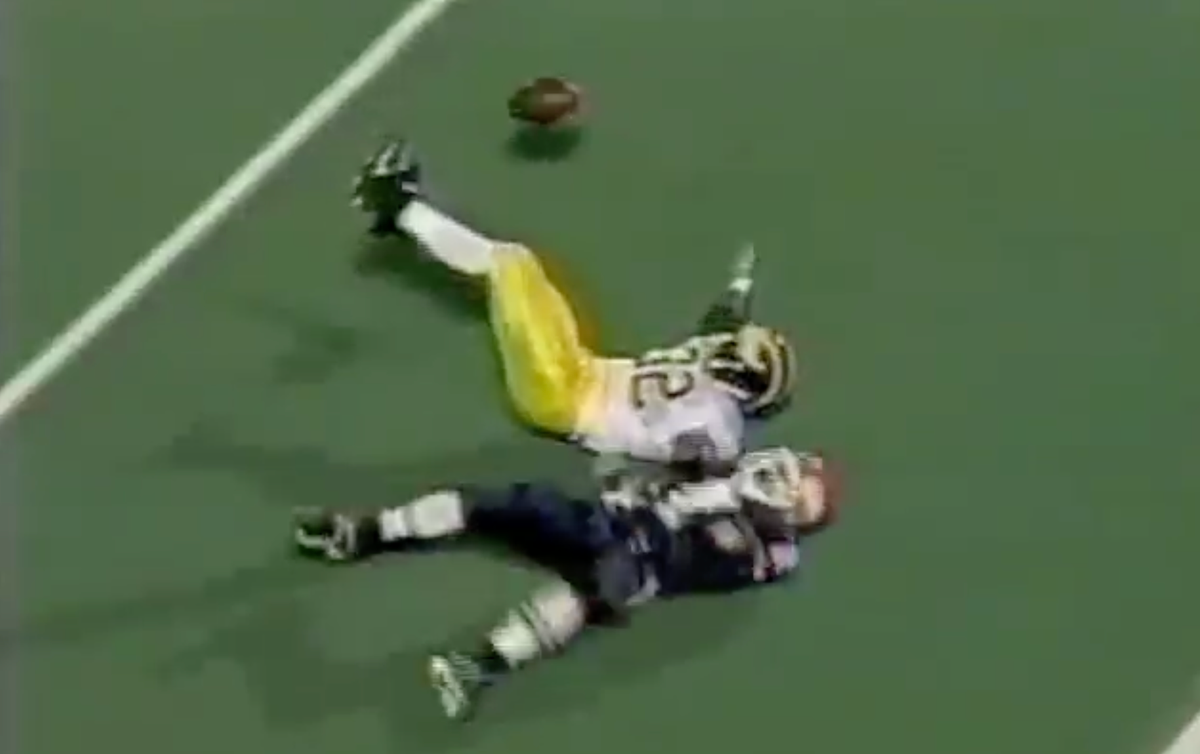
There were many bad calls in the Illinois-Michigan game in 2000 but the final two lost us the game. First off, while trying to run out the clock (with the lead with three minutes left), Rocky Harvey fumbled. Replay showed that the ground caused the fumble, and replay also showed that he had a clear recovery before Michigan jumped in the pile and ripped it out, but the officials gave Michigan the ball.
If this happened today, the replay would show on the big screen (in 4K, not the grainy screen grab below), it would be frozen at this moment, Illinois would challenge the call, it would be over turned, and Illinois would retain possession.
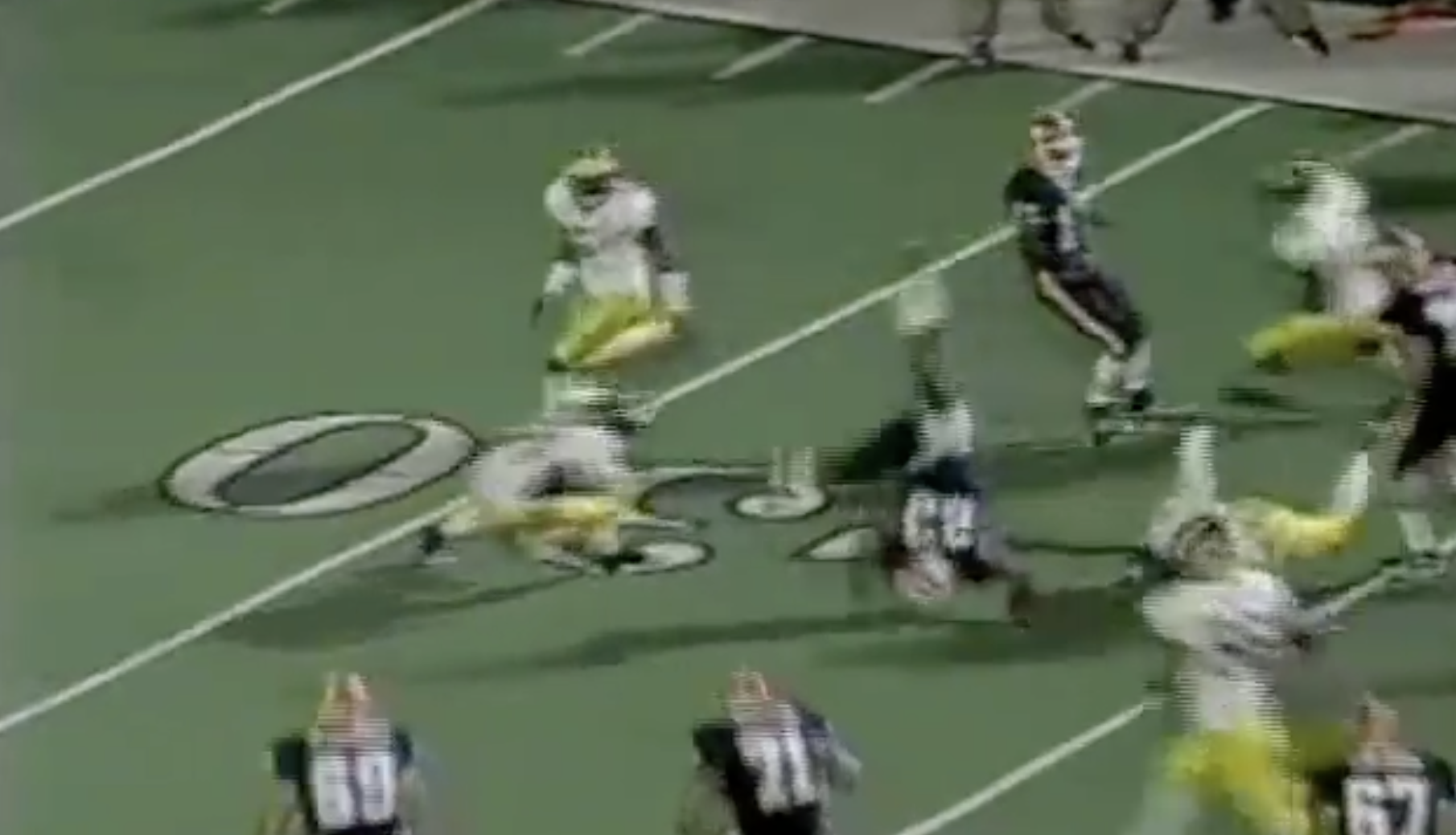
But there was no replay. The official on the field said he fumbled. So Michigan got the ball at our 27.
A few plays later, the most devastating call I can remember in Memorial Stadium. Michigan is driving for the winning TD. But a miracle happens. Bobby Jackson punches the ball out, Brandon Moore recovers (yes, he played defense here and then offense in the NFL) and we're going to win! But it was whistled dead. The officials said his knee was down.
Again, if this happens in 2026, the replay goes up, the crowd goes nuts when this is played...
...and then the replay would give Illinois the ball. Instead, it was just Michigan ball. There was zero mechanism to change it. Michigan scored a few plays later and won the game 35-31.
The Big Ten came out and apologized for both calls, but that just made it worse. It was this massive sold-out night game – #10 Michigan vs. #17 Illinois – and two bad fumble calls in the final four minutes cost us the game.
As the story goes, this moment started the shift towards replay in the Big Ten (the Big Ten was the first conference to use replay). The story always told was that because these calls gave Michigan a share of the Big Ten title that year, Ohio State switched their vote on replay. But according to Ron Turner, the story is deeper than that. Fast forward to exactly 41:50 in the podcast episode below to hear him tell me the story of replay:
So it wasn't "Ohio State flipped and that gave replay momentum." It was "JoePa made an impassioned speech about how Illinois got screwed and that led the rest of the schools to realize that Michigan and Ohio State consistently got all the calls with replay being the weapon to fight back."
This did not mean instant replay was immediately adopted. Like all rule changes, it was a series of committees needing to approve it. The coaches vote referenced there by Ron Turner happened in 2001, but it wasn't until the fall of 2003 that the Big Ten put in their instant replay pilot program. The NCAA (which had been fighting it) pushed back and the Big Ten had to put this "pilot program" on hold until the fall of 2004. And Joe Paterno was clearly the main proponent, especially after an overtime call against Michigan in 2002 (which Penn State fans have always claimed was the real reason for the Big Ten vote on replay). But whenever this is reference anywhere, even on Wikipedia, you can always see a reference to Illinois-Michigan 2000.
You're welcome, everyone.
3. Out Of Bounds Replay
While Penn State fans try to claim that their travesty led to college football replay (it was in motion years before), the college basketball out-of-bounds replay isn't debated. The rule was implemented before the 2013-14 college basketball season. And the play that every commentator referenced as an example of "in the last two minutes of regulation and the last two minutes of overtime" was this play in the Illinois-Miami game:
I still don't understand what the official saw. Brandon Paul was reaching for the airball but couldn't get to it because the Miami player swatted it out of bounds. To this day I don't understand why the official could see the ball swatted like that yet give the ball to the person reaching, not the person swatting.
Because the call was that egregious – instead of the ball with a chance to tie or take the lead with 39 seconds left, Illinois had to foul (there was a 35 second shot clock at the time) and Miami won it with free throws – replay was finally voted-in a few months later. It was the "man, there has to be some way to correct that in the moment instead of letting one call possibly decide the outcome" threshold for college basketball.
The "Illinois Rule" isn't actually in place anymore. This past offseason, "can be reviewed in the last two minutes" was removed and the coach challenge was introduced. Coaches can now challenge that call at any point during the game (just not with unlimited challenges). But the moment that introduced the sideline monitor? Illinois-Miami 2013.
You're welcome, everyone.
4. Jersey Number Swaps
These last two only happened in the last three years. So I don't fill the need to write a bunch of explainer paragraphs like I did for the first three. I think most Illini football fans remember both moments.
The first of these happened during the 2023 season and was changed in July of 2024. And despite my best efforts, it will likely be remembered as "players have to report jersey swaps to the officials now" which isn't the case. They always had to report. It was on the honor system. Luke Fickell did not follow the honor system and played dumb about the whole thing. And so the NCAA had to write out the honor system in their "I can't believe we have to say this, but..." rule change.
If you want to read a long explainer on it, read this article that I wrote in the summer of 2024. If you want a long explanation of that specific play in the 2023 Wisconsin game, I made this 25 minute video explaining everything (there are many, many layers to it). I'll try to summarize both in one paragraph.
College football depends on teams saying "#34 is Smith and #55 is Anderson." If players change jersey numbers, the officials aren't going to know. They haven't memorized every face and body type. So there's an honor system where you declare "this player is #82" which everyone follows. Wisconsin, wanting to run a trick play without having the player report to the official in his new (eligible receiver) number, warmed up a player in his real number, changed him into an (eligible) number at some point later, "forgot" to have him report, and ran a trick play to win the game with 31 seconds left.
Because of this, the NCAA added this rule the following summer:
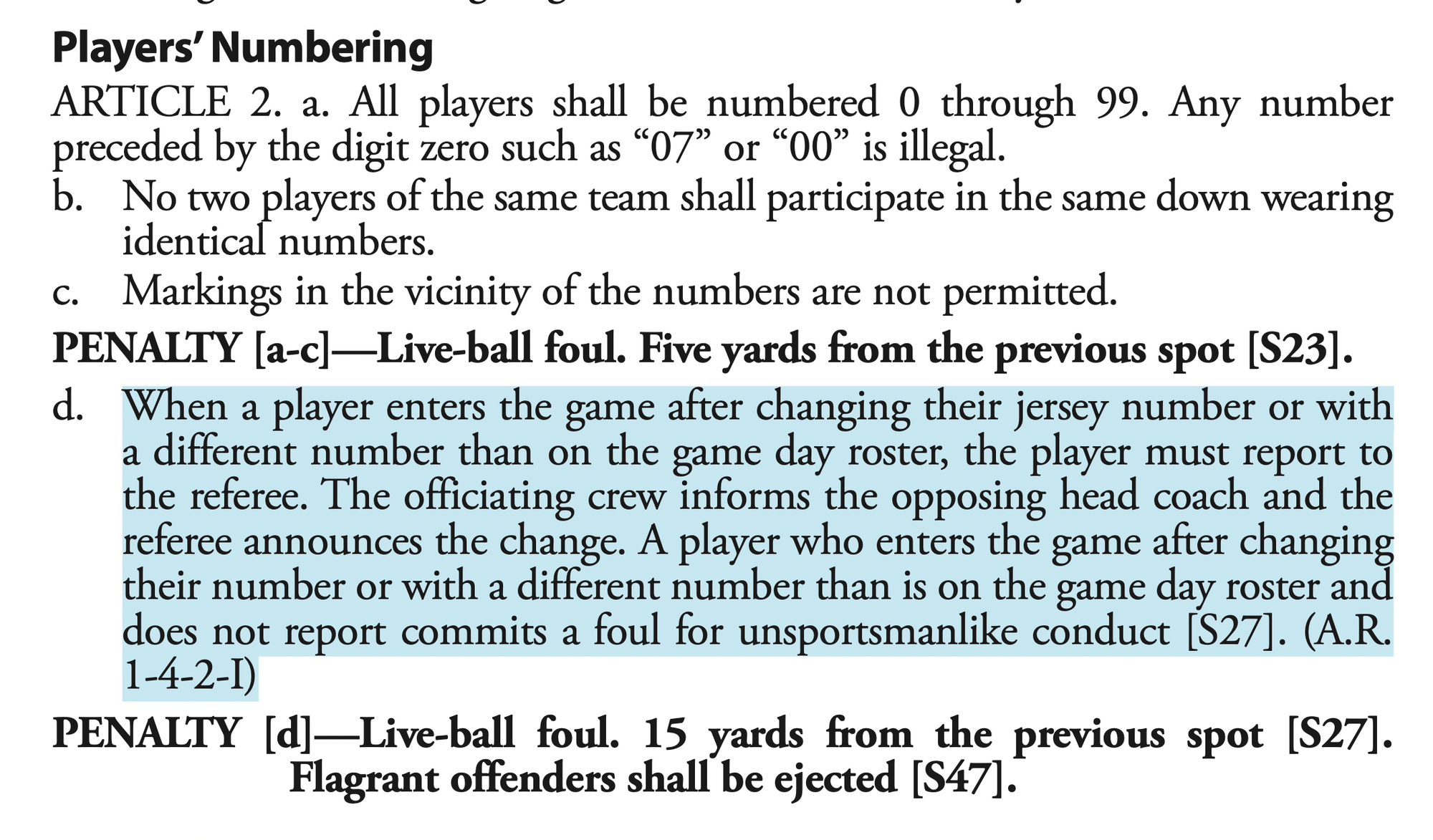
The first two sentences in the blue box had been in place (with slightly different wording) for several years. It was the last sentence that was added in 2024. It clarifies that if a team does what Wisconsin did they'd receive an unsportsmanlike conduct penalty.
Which puts this one on the "if called in the moment, Illinois likely wins the game" list. Wisconsin would have gotten a 15 yard penalty and would have had to try 3rd and goal from the 18 instead of the 3. Maybe they still score on third or fourth down, but most likely, Illinois wins that game.
And goes to a bowl game.
5. The T-Bar Signal
This one was just put in place last year. And requires the least explanation.
You remember the moment. Bret Bielema walks out on the field to check on an injured Juice Clarke in the Citrus Bowl and, since he's over by the South Carolina bench, he makes the t-bar gesture to Shane Beamer. Beamer loses his mind and acts like he wants to fight while his bros hold him back. The announcers think that the t-bar is a taunt because that's what the officials signal when a defensive substitution is taking place. But Bielema is referencing this South Carolina trick play on a kickoff:
As you hear the South Carolina announcer say there (it's a little hard to see on the broadcast), the returner put his arms out in the t-bar signal. That was the unofficial "I'm going to let it bounce in the endzone for a touchback" signal so that the kicking team, sprinting towards him, slow their sprint and avoid any contact with players on the receiving team. Kickoffs have a lot of injuries, so the t-bar signal was put in to say "I'm not catching this one so you don't have to engage."
And now it's the official signal for "I'm going to let it bounce in the endzone for a touchback." Because it was unofficial at the time (it was just a signal used for player safety), South Carolina flashed the signal and then brought it down to attempt a trick kickoff return (it didn't work - he got to the 25 which was... exactly where the ball would have been placed if it was a touchback). Now? Now if you flash the signal and pull it down it's the same as flashing a fair catch signal and then returning a punt anyway.
The rule change here is the same as the Kenny Pickett "you can't fake a slide" rule. The slide is there to protect quarterbacks from taking a headshot. So you can't fake the safety measure in order to trick a defender. If you do, you're... kinda smarmy like Kenny Pickett.
Or Shane Beamer.
The epilogue here is the second part of the question. A moment in history that should have been ILLINI RULE'd but wasn't. Things I considered:
- "Teams can't bulldoze James Augustine and foul him out in 11 minutes."
- "NCAA Golf should be decided by stroke play, not match play." (We'd have two national titles.)
- "If an official allows Mady Sisoko to break Ayo's nose without calling a foul on the play, that official should never work again."
But my choice is this:
I married a single mom. And because the boys' father wasn't involved, she was a one woman rules committee. The rules of the household were set by the time I came along. I jumped in midstream.
One of her parenting rules that I really liked: If one of the boys tattled on his brother, the brother would get in trouble for what he did... and so would the tattler. There would be punishment for what happened and an equal punishment for the tattling. Which meant that I can't remember a single tattle once I joined the family.
I simply want that rule put in place for Bruce Pearl. If Illinois gets Lack Of Institutional Control because Bruce Pearl turned us in to the NCAA, I simply want a Lack Of Institutional Control for Iowa for tattling. Yes, Pearl was fired by Iowa, but the school faced no punishment.
If I could ILLINI RULE any single moment it would be that. Record phone calls with a 17 year-old kid to turn in a competitor? That's fine, but if they are reduced to four total scholarships in the 1991 and 1992 recruiting classes, YOU are reduced to four total scholarships in the 1991 and 1992 recruiting classes. If they can't recruit off campus, YOU can't recruit off campus. Tattle and you face the same punishment.
If that had happened, Iowa basketball might have been so bad that they would have failed to make a single Final Four from 1980 to present.
Wait...
Comments ()