
Craig Has The Scout - Tennessee 2025
Coming Up
Who: Tennessee Volunteers
When: 4:30 pm – December 30th, 2025
Where: Nissan Stadium, Nashville, TN
How: ESPN
Opponent Primer:
Head Coach: Josh Heupel
Josh Heupel, the live action version of a grown-up Bobby Hill, and living proof of how the early Air Raid made legends out of mediocrity. Heupel propelled the Sooners to a national title before failing to play in the NFL. Oklahoma’s once‑golden Heisman runner‑up came back as a GA before Mike Stoops took him to Arizona for a year. He then spent almost a decade trying to bottle Sooner Magic before Bob Stoops gently escorted him to the curb for crimes against play‑calling. After a sabbatical in the coaching witness protection program at Utah State for a year, he resurfaced at Missouri. Barry Odom and Josh Heupel’s power combined led the Tigers to a 4-8 and 7-6 seasons before that résumé somehow made him the heir to the Scott Frost national championship UCF squad. Heupel’s tenure in Orlando was equal parts fireworks, indigestion, and plausible deniability. Nothing like inheriting a championship‑adjacent Ferrari and treating it like a rental.
As has been said before, it’s not what you know but who you know. The guy who hired Heupel at UCF is now Tennessee's AD; he brought Heupel with him after Heupel’s two years at UCF. Tennessee’s fanbase, insane but ever the optimist in abusive relationships, saw he was not Schiano and jumped in with both feet. Now on Rocky Top, Heupel runs a Veer‑and‑Shoot offense that runs more like a beater than a performance vehicle. He manages the clock like he thinks he can roll over unused timeouts to the next game. As early adopters of breaking all the rules in the new NIL era, Tennessee gave him a head start on building a championship roster which got them into the playoffs a year ago. Vols fans treat him like a deity because he finally ended their cursed losing streak to Alabama and smoked a cigar. However, after watching him lose to Vanderbilt to close out 2025, even they have to feel the creeping dread. Deep down, they know what’s coming: a future in which the rest of college football is paying too, dooming Tennessee to return to the middle of the SEC pack amid the faint smell of propane and propane accessories.
Offensive Style: Fast-paced modified Veer and Shoot (but don’t call it the Briles Offense).
Josh Heupel brought a fast-paced veer-and-shoot carnival to Tennessee from UCF. Art Briles was the first proponent and developed the system on the belief that if you stretch the field wide enough and snap the ball fast enough, you can create and exploit mismatches. Veer and Shoot receivers line up close enough to the sidelines to high-five the chain gang. SEC defenses are no longer confused by it though. Therefore, the Vols have compressed the splits this year, but Tennessee still pairs spacing with vertical choice routes, light box run math, and tempo to frustrate opposing defenses. It’s not an offense built for long, methodical drives as much as one for designed to generate three or four shot plays per game. If you can create enough confusion, the scoreboard will sort it out for you. When it works, the scoreboard lights up like a pinball machine. When it doesn’t, the quarterback gets planted.
Joey Halzle’s biography reads like the natural byproduct of living inside a system long enough that you start thinking in wide splits and tempo cues. Halzle was an Oklahoma quarterback under Heupel, where his core responsibility was making sure Sam Bradford was well hydrated. He then worked as an off-the field staffer before Heupel took him along through stops at Utah State, Missouri, UCF, and now Tennessee. He was the QBs coach at Tennessee until Alex Golesh left to take the South Florida job. Heupel elevated Halzle not because he needed a schematic overhaul, but because continuity was paramount and somebody had to be blamed for Joe Milton’s decision-making. It worked for Halzle too since he really liked introducing himself as a Heupel Disciple (that rhyme absolutely kills in Knoxville). His job isn’t to innovate. His job is to keep the gears greased, the quarterback going deep, and the tempo running just fast enough that no one questions what is really happening on Rocky Top.
Defensive Style: 4-2-5 multiple base emphasizing vertical rush with pattern matching quarters coverage.
Tennessee’s defense under Tim Banks was always a study in calculated risk, leaning heavily on simulated pressures, post‑snap movement, and the hope that chaos could paper over structural issues. Last season, the scheme at its best locked down opponents, creating confusion and covering up for an anemic offense. After losing two pass-rushers and the top corner, this year the scheme resembled a gambler continuing to double down on 13s. The Vols defense lived on pressure and schematic disruption because their lack of talent required it. When the disruption stopped landing it melted like a candy bar on the dashboard.
The huge slide this year led to the inevitable firing of Tim Banks. A DC only gets so many get-out-of-jail-free cards and Banks finally ran out. For this bowl game, linebackers coach William Inge is the interim DC tasked with preparing a unit that bent, broke, and then politely held the door open for opposing offenses all season. Jim Knowles has been hired as the permanent replacement, so Inge's interim tag feels less like a grand strategic pivot and more like the classic “someone has to call the plays, right?” moment. Inge inherits a unit that has spent the year oscillating between plucky and porous, and his job is basically to keep the wheels attached until the new year. Success will be defined as “not giving up 45,” but in true Tennessee fashion, Vols faithful will talk themselves into believing this is the spark of a new era right up until the first blown coverage reminds everyone why they hired Knowles in the first place.
Three Things to Watch
1. Tennessee QB Hurries. The Vols don’t bring pressure because they’re good at it; they bring pressure because they’re hoping something chaotic happens. With JC Davis opting out, Illinois must keep Altmyer clean and avoid the drive‑killing negative plays that Tennessee’s defense relies on to survive. If the Illini stay on schedule, the Vols’ structure tends to melt.
2. Tennessee number of plays. Tennessee wants to turn this into a track meet and exploit their superior depth. Illinois must slow down the Vols with late defensive rotations, well‑timed substitutions, and forcing the Vols into third‑and-medium where the tempo advantage disappears. If the Illini can make Tennessee look at the sideline, they’ve already won the down.
3. Hank Beatty and Tanner Arkin receptions. Tennessee’s secondary has been a choose‑your‑own‑adventure book of blown coverages all season. Illinois needs to hit the intermediate windows with digs, glance routes, and tight end seams. Altmyer needs to find the soft spots before the Vols’ disguised pressures get home.
What are they doing!? - Offense
Tennessee’s offense this year is an interesting experiment. In the off-season, Nico Iamaleava bolted for UCLA. His departure kicked off the Joey Aguilar experiment, a storyline that started as a contingency plan and somehow evolved into a statistical upgrade. Aguilar arrived from Appalachian State (and a spring at UCLA) with none of Iamaleava’s five‑star sparkle but plenty of actual production, finishing SEC play with 3,444 yards and 24 touchdowns. He brought a gunslinger’s confidence and the gunslinger’s occasional regret; those 10 interceptions weren’t accidents. Aguilar also brought something Tennessee desperately needed: a quarterback willing to take the boring throw on third down. The result was a 51 percent third-down conversion rate and an offense that, for the first time in years, didn’t treat check‑down like a dirty word.
The scheme around him shifted too, and not subtly. Tennessee compressed its receiver splits, abandoning the trademark sideline‑hugging width that had become so predictable that SEC defensive coordinators stopped pretending to be surprised by it. The Vols leaned into 12 personnel, using Miles Kitselman and Ethan Davis to protect Aguilar and open the middle of the field, a necessary adjustment for an offense that no longer had a bellcow back to bail it out. With Peyton Lewis, DeSean Bishop, and Star Thomas forming a committee rather than a threat, Tennessee’s run game became functional rather than frightening, which showed up most painfully in the red zone. Without a power runner or a dual‑threat quarterback, the field shrank, the playbook tightened, and drives that once ended in fireworks now ended in field goals.
Through all of this evolution (schematic, philosophical, and occasionally existential) offensive coordinator Joey Halzle was the one holding the clipboard and the Advil. Halzle oversaw the transition from gimmick accusations to something closer to an NFL‑adjacent offense, complete with route dips, tighter spacing, and an actual progression structure. He also oversaw the Vanderbilt implosion, a 45–24 loss so disjointed it fans wonder if the offense had simply wandered off mid‑game. But even with that stain, Halzle’s unit averaged 482 yards a game while developing bona fide stars at wide receiver. It wasn’t always pretty, and it certainly wasn’t always coherent, but the Tennessee offense did just enough to make you believe the next snap might be the one that ties it all together.
Joey Aguilar is the triggerman for Tennessee, and his road to Knoxville looks like a backwoods detour. He started at Diablo Valley College, broke out at Appalachian State, transferred to UCLA, only for Nico’s cross‑country relocation to leave him without a chair when the music stopped. After getting turned down by every quarterback with a pulse, Tennessee finally found someone whose “yes” matched their “please.” Aguilar arrived with production but not pedigree; once he won the job, he quickly became one of the SEC’s most fascinating statistical profiles. He’ll fire into tight windows without blinking, producing equal parts brilliance and bewilderment. The mix of gunslinger confidence and veteran comfort in the intermediate game produced Tennessee’s third‑down efficiency spike, and his volatility made him the kind of quarterback who can swing a Saturday by himself.
On tape, Aguilar shows the arm to hit the deep third, the toughness to stand in against pressure, and the processing speed to navigate Tennessee’s compressed‑set passing structure. He also shows the decision‑making that sparks hope on the opposing sideline and heartburn on this own. The turnover‑worthy plays are part of the package. Gambling folks call him a “market mover” because his style guarantees variance. When he’s sharp, he elevates the entire system. When he’s not, he stress‑tests its every seam.
Part of Tennessee’s reliance on Joey Aguilar traces back to losing Dylan Sampson, the bellcow who kept last year’s offense on schedule. In his absence, DeSean Bishop has become the statistical heartbeat of the run game. The Knoxville native started as a walk‑on, waited two seasons behind Sampson, and then turned himself into one of the SEC’s most efficient backs. His 163 carries for 983 yards and 14 touchdowns tell the story, averaging a robust 6.0 yards per carry. The style matters just as much. Bishop is a modern spread tailback: one‑cut acceleration, low center of gravity, and a knack for turning routine runs into chunks. His high‑volume high school background shows up in his balance and stamina, and Tennessee’s offensive rhythm tends to rise and fall with his usage.
Behind him is Star Thomas, the well‑traveled veteran who made stops at Coffeyville CC, New Mexico State, and Duke before becoming Tennessee’s change‑of‑pace hammer. He’s been the ideal complement, logging 95 carries for 529 yards and 7 touchdowns while offering just enough in the passing game to keep defenses honest. Thomas is a downhill runner built for gap schemes, a contrast to Bishop’s slashing style. His workload dipped late in the season, which opens the door for freshman Daune Morris to see more touches in the bowl game as Tennessee leans into their young talent.
The backfield was efficient while the receiving corps had the explosiveness. Their three top targets, Chris Brazell, Braylon Staley, and Mike Matthews, all finished top‑10 in SEC receiving yards. Brazell was the unquestioned WR1, a 6‑5 Tulane transfer who turned long strides into explosive plays and posted 62 catches for 1,017 yards and 9 touchdowns on his way to All‑SEC honors. He opted out of the Music City Bowl to prepare for an early‑round draft slot, leaving freshman Radarious Jackson to step into big shoes he's not quite ready to fill. Tight end Miles Kitselman, the Alabama‑to‑JUCO‑to‑Knoxville nomad, became a dependable chain‑mover with 25 catches for 250 yards and 2 scores, but he appears unavailable after missing the final two games.
With Brazell and Kitselman out, the passing game shifts squarely onto Braylon Staley and Mike Matthews. Staley, the redshirt freshman slot sparkplug, caught 64 balls for 806 yards and 6 touchdowns and walked away with SEC Freshman of the Year honors. Matthews, the former five‑star, provided steady production and a vertical threat that kept defenses honest. Ethan Davis will continue filling Kitselman’s role, but the real weight falls on Staley’s efficiency and Matthews’ explosiveness. It’s a bowl‑game blueprint that mirrors Tennessee’s broader youth movement: talented, volatile, and fully capable of stealing the show if the moment doesn’t get too big.
Tennessee’s offensive line is built around its bookends, a pair of tackles who combine five‑star pedigree with production that matches the billing. Lance Heard, the LSU transfer, has started all 23 games of his Tennessee career and allowed only three sacks across 1,780 snaps. His size, reach, and ability to erase edge rushers give the Vols a built‑in advantage every time they drop back. On the other side, David Sanders Jr. became one of the SEC’s most impressive freshmen, earning All‑Freshman honors despite missing early time with an injury. His athleticism and recovery skills make him a natural fit in Tennessee’s tempo‑driven run game, and coaches already talk about him as the heir to Heard’s blindside throne.
Inside, the Vols have leaned on Shamurad Umarov, Wendell Moe, and center Sam Pendleton. Moe should be out for the bowl after his Vanderbilt injury, which likely pushes Jesse Perry into the starting role. Perry, who narrowly lost the preseason guard battle, is a lengthy redshirt freshman. Pendleton has been the steadying force for a unit that has rotated as many as eight linemen in certain games, including the Alabama matchup where Tennessee shuffled bodies all night. This isn’t a dominant line snap‑to‑snap, but it’s stable enough to keep the offense on schedule and avoid the catastrophic negative plays that flip games.
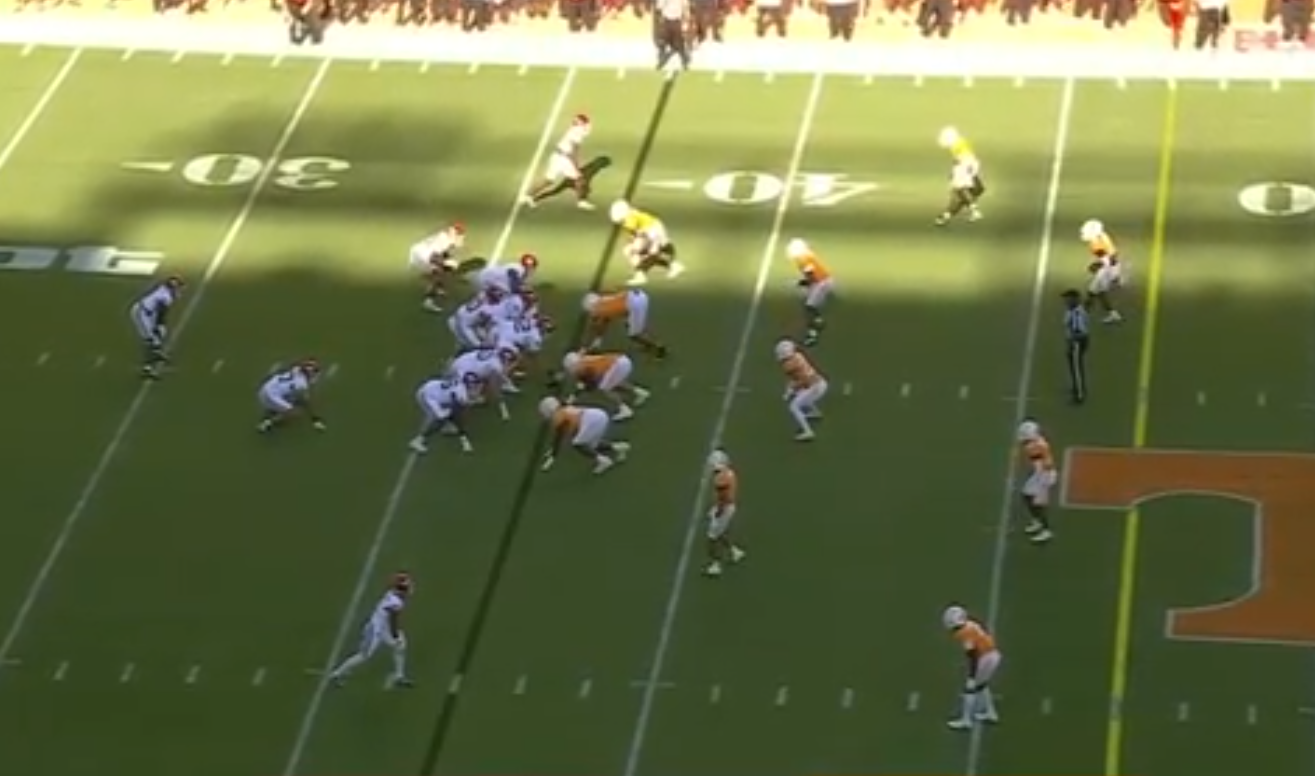
Tennessee’s run game leans heavily on gap schemes, especially the tackle counter that has become their comfort food. The appeal is obvious: downhill angles for the interior line and a chance to get those athletic tackles blocking in space. The Vols will do everything they can to coax Illinois into light boxes so the run game can breathe.
The tackles are the engine here. Their ability to pull cleanly makes the whole thing hum, and Tennessee will happily alternate which side pulls to keep linebackers guessing.
Here they pair it with an inline tight end. Since Kitselman’s injury, the Vols have leaned more on H‑back sets, but against Illinois’ five‑man front they may return to more inline looks to carve out lanes. They’ll also run the classic guard‑tackle counter.
Because Tennessee often sees light boxes and soft perimeter support, the backs rarely bounce anything. They stay between the tackles, get vertical, and trust the line to create steady push. Illinois’ interior is going to feel that pressure snap after snap. One of Tennessee’s favorite answers is the H‑back lead.
The H‑back isolates the playside linebacker while everyone else blocks DUO. Hitting the A‑gap works when the line is generating three yards of movement before contact. Tennessee has a B‑gap version too.
The tackle misses the end here and climbs anyway, but the H‑back still seals the edge. The blocking is consistently solid, though the loss of Moe opens a small window for Illinois to poke at a weaker spot.
There’s also a Power‑ish variant Tennessee likes against light boxes, with the H‑back climbing to iso a safety.
The line blocks DUO again and the H‑back leads through. This is especially effective against defenses that walk a strong safety into the box, something Illinois has done with Bailey most of the season. Expect this to be a staple call. If Illinois can’t choke it off early, the Vols will happily run them out of the building. And if the Illini do slow it down, there is always the RPO.
When the Vols are running into light boxes, they have had success all season. When they aren’t, the offense shrinks fast. Outside Zone is their change‑up, but it’s never been as effective because it squeezes the spacing they want in the passing game.
The H‑back hunts the first available crease and seals it, giving the back a lane to climb into the second level. For Illinois, the assignment is simple in theory and miserable in practice: muddy the box count, spill runs to help, and force Tennessee to play with patience. Tempo teams hate patience.
Where the run game really matters is in how it unlocks the passing script. Tennessee leans on play‑action and RPOs more than anyone not named Kirk Ciarrocca. The whole structure is built to manufacture mismatches and then hammer them. A functional run threat isolates receivers outside and opens clean windows for Aguilar.
If Tennessee is only pulling the guard, odds are high they’re throwing. Here, the play‑action sucks up both linebackers and leaves Davis alone for Aguilar to hit in rhythm. They’ll dress it up with max protection too.
This version clears out the middle and targets the intermediate crosser. It’s a notable shift from past seasons when the quarterback had to account for an unblocked rusher. This is far more QB‑friendly. And yes, the deep shots are still baked in.
Six‑man protection wasn’t enough here, and Aguilar couldn’t step into the throw, sailing it long. His arm is plenty live and he’s accurate when his mechanics stay intact. Move him off his spot and the ball starts wandering.
One of Tennessee’s most dangerous wrinkles against Illinois is leaking the H‑back after showing run.
The guard pulls instead of the tackle, and the H‑back slips into the flat with the outside receiver sealing the second level. Oregon torched Illinois with a similar TE leak last year, exploiting the athletic mismatch. This single concept will force Illinois into more zone looks so Davis isn’t left on an island without help.
Tennessee leans heavily on switch concepts in the passing game. The offense has morphed more towards West Coast structure rather than pure Air Raid spacing, and one of their staples is a near‑side switch with a slant and a flare.
Against man, the slant is a gift. Against zone, the far‑side Hitch‑Go combination usually isolates a receiver. The Vols thrive when Aguilar gets easy, pre‑determined answers. Illinois has to take those freebies off the table.
Vanderbilt lived in a two‑high shell against Tennessee, and Illinois should follow the same script. Sitting in two‑high makes the Illini light in the box and dares the Vols to run. Expect late rotations into single‑high looks, forcing Aguilar to move past his first read. The more Tennessee has to think, the less their tempo matters. If the Vols can run consistently, though, Illinois will have to drop a safety, regain numbers, and open themselves up to vertical shots.
Tennessee’s offense has spent the season reinventing itself, moving away from the sideline‑to‑sideline extremes of the Heupel era and into something that looks like a real system instead of a tempo experiment. Aguilar has been the pivot point, throwing for more than 3,400 yards with just enough chaos baked in to keep things interesting. The Vols tightened their receiver splits, leaned on 11 and 12 personnel, and embraced a more NFL‑adjacent passing structure built on intermediate throws and third‑down efficiency. The run game never fully clicked, leaving an offense that could rack up yards but sputtered in the red zone.
To beat Illinois, Tennessee needs the version of this offense that stays on schedule, protects Aguilar, and avoids the self‑inflicted wounds that have sunk them in losses. The compressed sets and tight‑end usage matter because they create clean interior matchups for Staley and keep the chains moving against an Illini defense that struggles to get off the field. Most of all, Tennessee has to finish drives. Field goals won’t win a game Illinois wants to shorten. If the Vols rediscover their red‑zone identity, keep Aguilar upright, and avoid the turnover‑heavy chaos that doomed them against Vanderbilt, they have the firepower to control the tempo and tilt the matchup their way.
What are they doing!? - Defense
Tennessee’s defense has been a season‑long case study in regression. After fielding an elite secondary last year, the Vols plummeted to 113th nationally in pass defense, surrendering nearly 250 yards per game and enough explosive plays to make opposing quarterbacks look like Heisman candidates for an afternoon. Communication breakdowns, youth, and a revolving door of defensive lapses turned routine coverage into interpretive dance. And yet, in classic Tennessee fashion, the defense still managed to lead the SEC in forced fumbles and was among the leaders in sacks, creating a feast‑or‑famine profile where they could score a defensive touchdown one drive and give up 80 yards the next. It was chaos, but not the kind the coaching staff intended.
The structural issues only deepened as the season wore on. Missed tackles piled up (98 in the first ten games), with defensive backs opting for shoulder‑checks that would make a hockey coach proud. Red‑zone defense cratered from top‑five nationally to 117th, allowing touchdowns on 75% of opponent trips. The interior pass rush evaporated without the veterans who anchored it in 2024, leaving quarterbacks far too comfortable while the secondary scrambled downfield. Even the depth that once defined Banks’ fronts disappeared, shrinking the defensive line rotation and producing fourth‑quarter fatigue so visible that Alabama and Vanderbilt practically ran the same plays repeatedly just to prove they could. Add in the midseason departure of Boo Carter, whose exit forced walk‑ons into high‑leverage snaps, and the entire unit felt like it was held together with athletic tape and wishful thinking.
All of this culminated in the unsurprising post‑Vanderbilt firing of Banks, whose inability to adapt the scheme to a younger roster forced Heupel to hit reset. Still, the defense had some bright spots: Arion Carter emerged as the heartbeat of the unit, Ty Redmond and Colton Hood became weapons, and the raw ingredients for a rebound are on the roster. But in 2025, the Tennessee defense lived in extremes. They were opportunistic but porous, talented but inconsistent, explosive but unstable. This Vols defense was a unit that could swing a game in either direction, sometimes within the same quarter.
Tennessee under Banks operated out of a hybrid 4‑2‑5 structure built around multiplicity and pressure, a continuation of the philosophy he carried from Penn State and Illinois. Banks’ best units were defined by physicality and adaptability, with fronts that shifted between even and odd spacing to manufacture one‑on‑one matchups. Banks leaned heavily on simulated pressures and creepers, often presenting six‑man pressure looks before dropping into zone coverage to protect a secondary. The base coverage was quarters, but he frequently spun safeties late to disguise rotations, a hallmark of his Penn State tenure. Banks pressure menu includes boundary‑side fire zones, nickel‑off‑the‑edge blitzes, and interior mug looks designed to stress protections without fully committing extra rushers. When the defense faltered, breakdowns in tackling and secondary communication rather than schematic flaws doomed them. Banks’ identity centered on creating chaos early in a drive, forcing hurried decisions, and relying on depth along the defensive line to rotate and maintain pressure across four quarters.
Tennessee’s defensive line starts with Dominic Bailey, the late‑career breakout who finally became the steadying force coaches kept waiting on. A former blue‑chip from Maryland, Bailey survived multiple position‑room overhauls and entered 2025 as the most seasoned interior lineman on the roster. He’s played like it, posting top‑three run‑stop numbers on the team and one of the SEC’s better interior pressure rates. Next to him is Bryson Eason, back for a sixth season and still anchoring the nose with the same mass‑and‑motor blend that made him the quiet glue of the 2024 front. The converted linebacker from Memphis brings lateral quickness and pursuit range you don’t usually get from a nose, and his pad level gives interior linemen headaches. After those two, the experience drops off fast.
Daevin Hobbs is the traits player of the group. Long, explosive, and still figuring out how good he can be, this was his first year as a true feature piece. The former five‑star with basketball feet has flashed the ceiling that made him a national recruit, and his pass‑rush win rate has climbed steadily all season. He’ll be a real problem for Illinois’ tackles. Behind the starters, the rotation is functional but thinner after the opt‑out of Joshua Josephs, Tennessee’s most explosive wide‑alignment rusher. Nathan Robinson gives sturdy early‑down snaps, Tyre West remains the volatile but powerful interior penetrator, and Tyree Weathersby has emerged late with encouraging technique growth. It’s not the deepest Tennessee line in recent memory, but when Bailey or Hobbs wins early in the count, drives can flip in a hurry.
Caleb Herring’s move into a full‑time LEO role has been one of Tennessee’s better internal promotions, a long‑limbed, twitchy edge hybrid finally playing like the athlete they signed. His past life as a high‑school receiver and basketball standout still shows up in his stride length and pursuit angles, and his production reflects a player who has grown into the job’s physical demands. With Arion Carter opting out, Tennessee needs Herring to be more than a complementary piece. Carter was the defense’s most explosive second‑level playmaker; Herring is more of a variance reducer than a chaos engine, but the Vols need his stabilizing presence to keep them out of the defensive spirals that have doomed them in losses.
Jeremiah Telander has become the steady downhill anchor of the group, quietly stacking strong performances as he grows into the MLB role he was originally projected for. Edwin Spillman, meanwhile, has made the sophomore leap Tennessee hoped for, emerging as the rangiest linebacker on the roster and giving the defense a badly needed sideline‑to‑sideline presence. Depth behind them is young but intriguing. Jadon Perlotte has flashed in spot duty, while Jordan Ross is expected out, leaving Christian Gass and Jordan Burns battling to be the next LEO up. It’s a talented but very young room; no player has expiring eligibility. The drop‑off becomes immediately noticeable when the backups are forced into extended snaps.
Tennessee’s biggest defensive liability has been the secondary, and losing its top two corners to opt‑outs didn’t help. That pushes Ty Redmond into the CB1 role, which is at least a promotion he’s earned. Redmond has been Tennessee’s most productive perimeter defender with 8 PBUs and 3 interceptions, and his length and recovery speed are the only reason this transition isn’t a full‑scale emergency. He’ll need both to survive the losses of Colton Hood and Jermod McCoy, the latter being the defense’s most experienced cover man before shutting it down for the draft. William Wright is the likely next starter, a redshirt senior and special‑teams mainstay Tennessee hopes can give them a technically sound, low‑variance presence on the outside.
On the back end, Edrees Farooq has quietly become one of the SEC’s most productive safeties, piling up 71 tackles, four forced fumbles, and two interceptions. The Maryland product is versatile enough to play top‑down, rotate into the slot, or trigger downhill, though his late diagnoses leave him vulnerable to shots over the top. Andre Turrentine complements him as the steadier, assignment‑sound veteran, settling into a reliable deep‑half role after arriving from Ohio State. Nickel Jalen McMurray has been the most important matchup piece, handling motion, bunch sets, and slot verticals with the experience he brought from Temple. The depth behind those guys is functional but fragile. Kaleb Beasley and Tre Poteat are still developmental players, and opposing offenses know it. The result is a secondary that’s volatile but opportunistic, capable of stealing possessions but far more prone to miscommunication and coverage busts.
With Jim Knowles watching from the sideline, the real question is how aggressive Tennessee wants to be. Tim Banks manufactured chaos using simulated pressures, post‑snap movement, and negative plays born from confusion. Knowles, by contrast, prefers pattern‑match structure and disciplined fits, a system that relies less on hero ball and more on everyone doing their job. Banks chased one‑on‑one mismatches while Knowles chases predictability.
If William Inge keeps the Banks blueprint intact, Tennessee will bring steady pressure despite the three major opt‑outs. One of their staples is the nickel overload blitz.
Tennessee is at its worst when linebackers have to diagnose anything after the snap. Expect Barry Lunney to lean into eye‑candy: orbit motion, counter looks, and RPO tags designed to freeze those linebackers just long enough for Illinois’ run game to get downhill. With Arion Carter out, Tennessee will try to protect the second level by sending them instead.
The Vols pair these pressures with press coverage, trying to force the quarterback into danger throws. They’ll also dress up the same concept by dropping the LEO into coverage.
The LEO drop turns the look into zone and puts defenders in spots a rattled quarterback doesn’t expect. Illinois needs to borrow from Vanderbilt’s plan and make Tennessee’s defensive backs tackle in space.
The corner taking the atrocious pursuit angle is Colton Hood, who opted out. His replacements are worse, which is saying something. Banks also loved dialing up six‑man pressures, and Inge is likely to keep that page in the call sheet.
This package helped Tennessee climb the national sack charts. It’s also why they lived near the bottom of the SEC in yards per attempt allowed. Banks’ boom‑or‑bust approach swung multiple games this season, especially when early leads evaporated under the weight of coverage busts and fatigue.
Tennessee’s edge defenders are coached to gamble in ways Illinois’ aren’t. With the Vols’ athleticism, it’s not the worst idea. The Vols DL is quicker off the edge than most opponents and win plenty of reps on pure twitch. One example is this spin move.
Fortunately for Illinois, Joshua Josephs, the owner of that nasty spin, opted out. But the instinct to chase splash plays is baked into Tennessee’s DNA. It shows up most when the offense is behind the chains, which Illinois must avoid at all costs. The flip side of all that freelancing is rush‑lane chaos that opens escape routes for quarterbacks.
Here, Perlotte blitzes himself completely out of his lane, giving Pavia a runway. Altmyer will have chances to step up and steal yards if Tennessee keeps rushing like this.
The same hero‑ball mentality shows up in the run fits. When defenders try to win every rep individually, vertical creases appear.
Carter overpursues and leaves a seam for the back. This wasn’t a one‑off but a recurring issue all season. Illinois’ backs will need patience, because the holes will be there if they can let the play develop.
Tennessee’s defense has spent most of the season searching for its identity, and the results have been uneven at best. The secondary, a strength a year ago, struggled to keep pace with opposing passing attacks. The front seven created havoc both for opponents and the back seven. Missed tackles, inconsistent gap fits, and a red-zone unit sponsored by the number 6 combined to create a defense that looked sharp one series and lost on the next. The havoc plays couldn’t overcome the underlying instability. The Vols saw early leads slip away as the offense faltered and the defense cratered. Georgia and Oklahoma both put together strong second half offensive performances and the lopsided loss to Vanderbilt doomed Banks, leaving Inge with plenty of loose ends to tie up.
Against the Illini, Tennessee needs to steady the parts of the defense that have wobbled all fall. The Illini will test communication on the matching coverage, gap discipline and tackling fundamentals, all of which are areas where the Vols have been lacking. Without Banks, Inge should simplify the plan and force Illinois to string together drives. He’ll have to simplify the game for the LBs though. Illinois will provide plenty of eye-candy so keeping coverages basic while bringing edge pressure should prevent the explosive plays that plagued them this season. Illinois’ offense thrives when opponents give them free yards and lose leverage, so Tennessee’s margin for error is slim. If the Vols manage their run fits, avoid the coverage busts from earlier in the season, and get edge pressure they’ll control the matchup and prevent the fiery end featured too often this season. All they have to do is not be the team they were for most of the season.
What does it mean?
On both sides of the ball, this is a contrast of styles. The Vols offensively are built on tempo, spacing, and the hope that Aguilar hits enough deep shots to make you forget the throws he missed off-platform. Their offense is a renovated version of the Heupel machine, less sideline‑to‑sideline chaos and more compressed sets, play‑action, and intermediate throws. The run game is efficient when the box is light, the receivers are explosive and the OTs are both future pros. If Tennessee dictates tempo, Illinois is in for a long afternoon.
The flip side is the Tennessee defense. They lost their coordinator, lost their top corners, and most likely will still insist on living in a pressure world that creates as many gifts as it does sacks. The linebackers struggle with post‑snap reads, the secondary miscommunicates like it’s a hobby, and the whole structure is one big dare. If the Vols hit explosives, they get the shots they want to flip the game with superior athleticism. If they don’t, the Illini get to watch Tennessee’s defense unravel in real time.
For Illinois to Win:
The Illini need to execute and do what successful Bret Bielema teams do: control the pace, win the efficiency battle, and keep the game on script. Illinois needs to stay ahead of the chains and avoid the negative plays that Tennessee’s athletic front can generate. The Illini will be without J.C. Davis, so they must protect Altmyer with quick-game rhythm and a heavy dose of misdirection to neutralize Tennessee’s speed. If Illinois can turn this into a possession game, finish drives, and force Aguilar to operate methodically rather than explosively, they can drag the Vols onto the struggle bus.
For Tennessee to Win:
For Tennessee, the formula is to speed the game up, create chunk plays, and let Aguilar take shots down the field. The Vols’ offense is built to stress secondaries vertically, and Illinois’ pass defense has been suspect. Tennessee’s defense is in flux after Banks’ firing, but the Vols still have enough athleticism to disrupt Illinois if they can force long-yardage situations. If Tennessee can establish a quick tempo, get Illinois chasing points, and turn this into a 70‑snap track meet, the Volunteers’ explosiveness becomes the defining trait of the game
Illinois +2.5
This is a stylistic tug-of-war. Illinois’s defense likes to play bend-but-don’t-break, and the Vols want chunk plays. The Illini offense wants to stretch defenses and win schematically while Tennessee relies on raw athleticism. The advantage leans toward the team that can create more chunk plays (Tennessee), but the gap is small enough that Illinois’ ability to dictate tempo is a legitimate equalizer. Weather could play a big factor, which adds a dimension Tennessee hasn’t dealt with, but the Illini played their worst game of the season in similar conditions. Both quarterbacks will have moments, but the game will likely be decided by red-zone execution and which defense avoids the backbreaking bust. The spread has moved from 6.5 to 2.5 over the last few weeks. The Tennessee offense looks largely intact though, and I think the Illini struggle to keep Aguilar from hitting early deep shots. While the Vols collapsed multiple times during the season after having a big lead, I don’t know if the Illini will be able to stack drives to wear down the Vols defense. I think the athleticism will cause issues for Illinois and the Illini will lose the turnover battle. Give me Tennessee to cover in a matchup of two teams that have been inconsistent but dangerous.
YTD Against the Spread:
8-4
Comments ()