
Craig Has The Scout - Iowa 2026
Coming Up
Who: Iowa Hawkeyes
When: Saturday, November 21, 2026, at 1:30 p.m.
Where: Home Sweet Home
How: BTN
Opponent Primer:
Head Coach: Kirk Ferentz
Kirk Ferentz’s tenure has evolved from a coaching job into a geological era. Since taking over in 1999, he has outlasted players, athletic directors, conference realignment, the BCS, the four-team playoff, the dawn of the NIL era, and now the twelve-team playoff. The man Hawkeye fans wanted to replace him, Bob Stoops, started at Oklahoma the same year, won a national title, retired, moved on to a UFL career and retired again, all while Ferentz kept chewing his gum on the sidelines in Iowa City. His has created the cult like devotion colleges reserve for coaching legends. Unlike Happy Valley, in Iowa City the staff's interaction with children is limited to waving at the hospital after the first quarter.
The most remarkable thing about Ferentz may be that he has never appeared to enjoy any of it. Watching him approach a postgame podium feels less like a press conference and more like a hostage negotiation with a man who considers basic human enthusiasm a character flaw. His expression toggles between mildly disappointed and deeply aggrieved, as if someone just told him the hotel breakfast buffet ran out of plain oatmeal. While most coaches use the media to hype up their schemes, standouts, and transfer portal hauls, Ferentz treats the microphone like a suspicious package, delivering monotonous non-answers about quarterback battles ("we'll know when we know"). He hasn't displayed a full range of human emotions since the Clinton administration, yet he commands the room with the gravitas of a man who knows he has a lifetime contract and zero obligation to entertain you.
That weaponized boredom translates directly to Saturdays. Ferentz has spent nearly three decades conducting a weekly experiment to determine the minimum amount of offense required to legally participate in a football game. His football philosophy is so conservative the Amana Colonies down the road are asking him to modernize. His ideal Saturday consists of a defensive touchdown, two field goals, six punts, a 13–10 victory and a fanbase consuming an unhealthy amount of Busch Light required to appreciate it.
Even Ferentz briefly discovered the outer limits of his own philosophy during the Brian Ferentz years, when nepotism crossed over into performance art. Most coaches would have overhauled everything. Ferentz adjusted just enough to remain Ferentz. It may be the greatest job in sports. The defense is going to line up and try to maul you, his offense operates under what appears to be a court-ordered restraining order against the end zone, and he goes 8–5. Everyone calls it another solid season and Ferentz is treated like royalty despite possessing all the charisma of a bathrobe.
The true masterpiece, though, is how Ferentz convinced an entire state that emotional suffering is actually school spirit. Iowa football is no longer a fan base but a support group suffering from a severe, statewide case of Stockholm syndrome bundled with season tickets. Fans travel to Kinnick to watch nine punts while wearing their Hawkeye logo and reassure themselves they’re witnessing tradition. Meanwhile, Ferentz collects $7 million per year, wins eight games, and sends everyone home believing the pain was the point all along.
Offensive Style: Pro Spread offense with heavy personnel pairing wide-zone and play-action.
Tim Lester is the man who finally brought a passable offense to Iowa City. He took a meandering path to get there. Lester starred at Wheaton Warrenville South, became a four-year starter at Western Michigan, then graduated into the glamorous life of a high school math teacher who spent weekends quarterbacking in the XFL. His Chicago Enforcers went 0-4 in his starts and scored three points in two of those games. Most coaches would spend years trying to outrun that statistic. Lester turned it into a qualification for running Iowa's offense.
From there he pinballed across the football map. Two high schools. Elmhurst College as offensive coordinator. A now defunct Saint Joseph's as head coach. He got his first major opportunity back at Western Michigan under Bill Cubit for two years, before he was tossed out when Ryan graduated. Then came a year coaching defense at North Central, followed by the head job at Elmhurst. There he won a conference title and later watched the NCAA politely erase ten victories from the record book. Syracuse came next under George McDonald. He inherited play-calling duties after Scott Shafer fired his own longtime friend, then lost the job when Shafer got fired anyway.
Then came Purdue under Darrell Hazell, which is like saying you learned investing from a guy at the craps table with a system. Hazell was fired, Lester went with him and somehow landed on his feet at Western Michigan as PJ Fleck's replacement. Six seasons later he left with a 37-32 record that nobody outside Kalamazoo remembers. After that he became a Packers analyst where he learned the Shanahan offense, then Ferentz hired him to rehabilitate an Iowa offense after Brian was fired. Lester inherited what looked like evidence from a criminal investigation. Calling Iowa's offense broken undersold things, broken things usually show signs of life.
Lester's scheme comes from the Shanahan tree, which means wide zone runs, play-action boots, crossing routes, and quarterbacks occasionally throwing to wide receivers who are actually schemed open on purpose. The offensive line flows laterally, the backs press outside, and the defense gets stretched until bootlegs and shot plays emerge on the backside. Pre-snap motion exists to create leverage. There are still tight ends everywhere because it’s Iowa and some traditions are more important than state landmarks. The offense wants the run to open up easy passing lanes, and utilize a quarterback and receivers competent at a P4 level.
Defensive Style: Disciplined 4-2-5 zone coverage scheme
Phil Parker ranks somewhere between the Field of Dreams and loose meat sandwiches on Iowa's list of cultural treasures. A defensive back at Michigan State under George Perles, Parker began his coaching career there in 1987 as a graduate assistant working under a young Nick Saban. He spent the next eleven years coaching defensive backs at Toledo, first under Saban and later under Gary Pinkel. When Kirk Ferentz took the Iowa job in 1999, Parker followed him west and joined the staff under defensive coordinator Norm Parker, one of his former coaches at Michigan State. Phil spent thirteen seasons coaching Iowa's secondary before taking over the defense in 2012 when Norm retired. Norm’s approach was using a classic 4-3 defense that rarely blitzed and kept the ball in front at all costs. Phil still pays homage to his defense by listing three linebackers in the starting lineup.
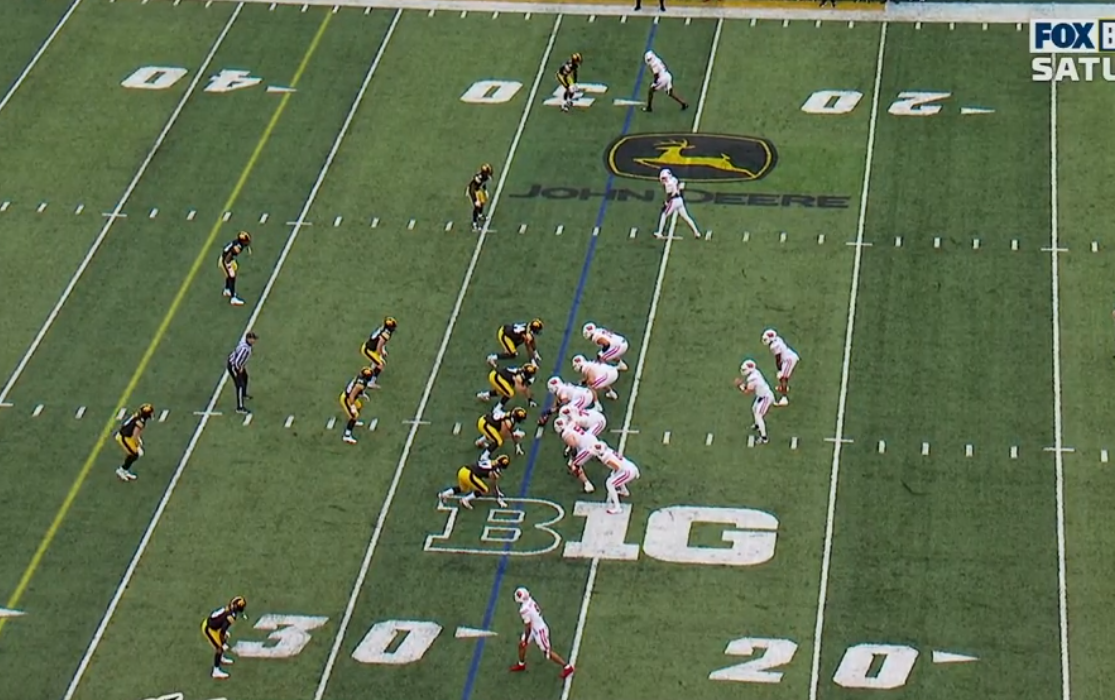
Parker's defense is engineered to make every drive feel like waiting in line at the DMV. The base is a 4-2-5 that shifts into a 4-3 against heavier personnel, with an assembly line of defensive linemen rotating on and off the field. The coverage backbone is quarters coverage. Both safeties line up deep on most early downs, in a version that plays more like true zone than the man-match styles favored elsewhere, and the whole point is to keep everything in front. Blitzes are rare on early downs, climb on third and short, and spike on long yardage. The goal is to get offenses behind the chains to a third and long, where Iowa has been brutally good. The weakness is also on tape. Anything that thins out the box and sends the defense one way before attacking the other, like counters, RPOs, and pre-snap motion, gives Iowa trouble. Parker has also been willing to tinker, including some 3-3-5 looks. For most of 25 years the scheme has been the football equivalent of a church potluck casserole, a tried and true recipe that isn’t flashy but always delivers.
Three Things to Watch